How milk turned into something new
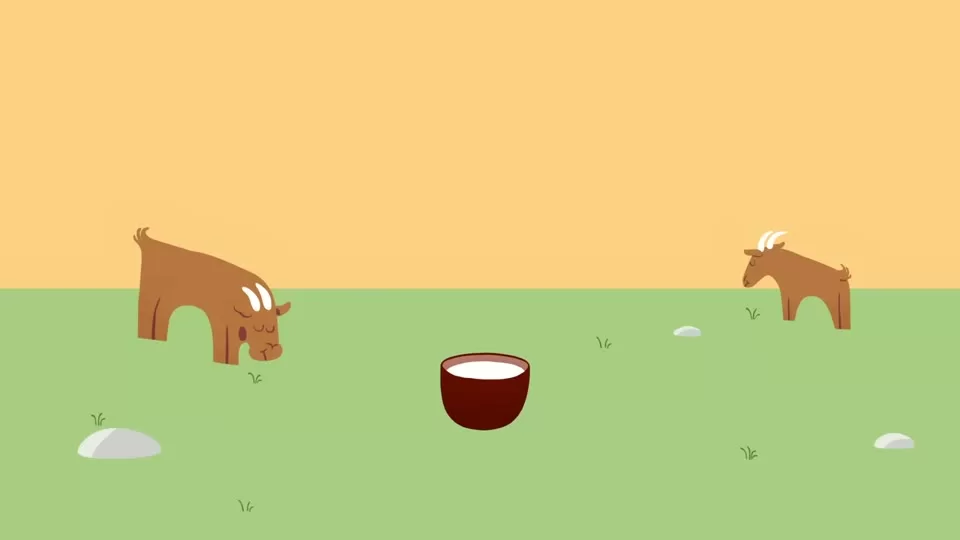
Cheese probably began with a small accident. Fresh milk was left out in warm weather, and after a few hours it soured. The acids in the milk made the proteins clump together, creating soft curds and a watery liquid called whey. Someone noticed that the curds were edible, and just like that, a new food took shape.
That basic idea still explains a lot of cheese today. The big difference is that people learned to control the process instead of waiting for chance. In plain terms, cheesemaking is a way of turning milk into a more stable, more portable food.

One thing is worth handling carefully: the exact origin date is not pinned down to a single year. Agriculture and milk use are directly documented in the Near East by the 7th millennium BCE, while the earliest clear evidence for cheesemaking itself comes later, especially from Neolithic Europe and the Mediterranean. So cheese is safely ancient—at least 7,000 years old—but 8000 BCE should be treated as a possibility, not a certainty.
Why cheese mattered so much to early farmers
Milk is nutritious, but it comes with a problem: lactose. Many people, ancient and modern, have trouble digesting it in large amounts. Cheese solved that problem neatly. Once the curds were separated from the whey, much of the lactose stayed behind, leaving a food that kept the good parts of milk with less of the sugar that causes trouble.
That made cheese especially useful for Neolithic communities. It offered proteins, fats, and minerals in a form that could be stored, moved, and eaten later. In a world with scarce winters and unpredictable harvests, that mattered a lot. Cheese was not just tasty. It was survival food.

Archaeologists do not usually find ancient blocks of cheese. They mostly find residues. For example, pottery fragments from Turkey dating to the 7th millennium BCE still carry traces of cheese and butter. Similar chemical evidence from perforated vessels in Poland shows that people were separating curds from whey, and finds from the Dalmatian coast of Croatia point to cheese production by about 5200 BCE.
From household food to trade good
Once people learned to make cheese on purpose, it did not stay a local trick for long. By the end of the Bronze Age, cheese was a standard trade item around the eastern Mediterranean. It also turned up in some of the earliest writing, where Mesopotamian records list cheese quotas for different groups and rituals. That is a pretty good sign that cheese had become important enough for administrators to track carefully.
Cheese was also useful because it traveled better than fresh milk. It could be stored, traded, and packed for long trips. That is one reason it appears so often in the history of mobile armies and long-distance exchange. Food that keeps its shape has a real advantage.

A related step in cheesemaking was the use of rennet, a substance found in the stomachs of certain mammals. Its main enzyme helps milk coagulate in a firmer, more controlled way than simple souring alone. In modern terms, acidity and rennet are different tools: acid curdling usually makes softer fresh cheeses, while rennet helps create firmer cheeses. Many cheeses use both.
Different regions made cheese their own
As cheesemaking spread, local cultures adapted it to whatever milk, climate, and tools they had. Nomadic Mongolians used yak milk to make hard, sun-dried wedges of Byaslag. In Egypt, goats’ milk cottage cheese was strained with reed mats. In South Asia, milk was often coagulated with acids like lemon juice, vinegar, or yogurt, then pressed and dried into paneer.
Each version fits its setting. Paneer works well in curries and sauces, and it can also be fried. Feta developed as a salty brined cheese in the Greek world. A harder grating cheese, similar to pecorino romano, was produced in Sicily and used across the Mediterranean. The names differ, the methods differ, but the core idea stays the same: change milk into something more durable and more versatile.

If you want a quick comparison, this helps:
| Method | Result | Typical outcome |
|---|---|---|
| Acid curdling | Milk separates with lemon, vinegar, yogurt, or natural souring | Soft, fresh cheeses like paneer |
| Rennet coagulation | Enzyme action firms the curds | More elastic, often aged cheeses |
Monasteries, Rome, and the rise of famous cheeses
Under Roman rule, cheese became part of military life as well. “Dry cheese,” or caseus aridus, was an important ration for soldiers guarding the empire’s long borders. That makes sense. Cheese is compact, nourishing, and easier to carry than fresh dairy.
After the Western Roman Empire fell, cheesemaking did not disappear. It kept evolving in medieval manors and, especially, in Benedictine monasteries across Europe. Monks experimented with milk types, aging conditions, and production methods. That slow, careful work helped shape several cheeses people still know today, including Parmesan, Roquefort, Munster, and various Swiss types.

Swiss cheesemaking became especially successful in the Alps, where cow’s milk was turned into many regional cheeses. By the late 14th century, cheese from the Gruyère region was so profitable that a neighboring state invaded the highlands to control the trade. Cheese can be valuable. Sometimes surprisingly so.
For a broader look at how food, craft, and daily life connect across regions, you might also enjoy this guide to Algeria’s Mediterranean and Saharan everyday culture.
From handcraft to industrial production
Cheese stayed popular through the Renaissance, then changed again during the Industrial Revolution. Production moved out of monasteries and into machinery. That shift made cheese easier to produce at scale, which is why it eventually became a global commodity instead of a mostly regional food.
Today, the world produces roughly 22 billion kilograms of cheese each year. That number is huge, but it grew out of the same basic pattern that began in the Neolithic world: milk, curds, whey, time, and human attention. Even now, local farms still make cheese by hand, following methods that are far older than most written history.

If you like stories about how ordinary things become part of bigger social change, this article on the power of beginnings is a nice companion read.
And for readers interested in the practical side of daily life and maintenance, the long-term effects of missing teeth is surprisingly relevant too, because diet and dental health often shape what people can comfortably eat.